When Training Standards Lose Touch with Reality
October 20, 2026
The Hux Bar problem and the cost of irrelevant training
By Chief Joe Maruca (Retired)
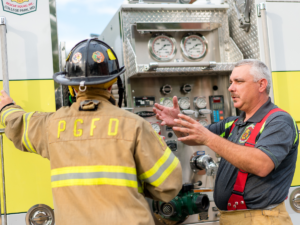 Training programs loaded with topics that aren’t relevant to the needs of small fire departments are keeping potential volunteer firefighters from joining up. They’re also influencing volunteers’ decisions to leave the service. So why do we include these topics? Why do we teach our firefighters about, say, the Hux Bar?
Because they’re in the textbooks. The latest versions of Firefighter Essentials and the new Support Person textbook all include the Hux Bar. And if OSHA has its way, the minimum training requirement for every American firefighter becomes Firefighter I, and questions about the Hux Bar could be on a class test or even on the certification exam.
After 45 years in the fire service in Massachusetts, I’ve never used or even seen a Hux Bar. They’re out there, sure. They’re made of steel and never wear out, and we in the fire service never throw anything away. But does everyone use them? Do new recruits need to learn about them? Probably not. As far as I can tell, you can’t even buy a new one; they haven’t been manufactured in decades.
For another example, consider this: At least half of the fire departments in the United States, particularly those in towns smaller than 2,500 people (about 45% of all departments in the U.S.) don’t have an aerial ladder truck, don’t have foam firefighting capabilities, or don’t have access to fire hydrants. Why does the federal government, through OSHA, or anyone else, feel we need to mandate training in areas that are not relevant to more than half of firefighters in the country?
One last example, just to emphasize the wide range of topics everyone will have to learn if Firefighter 1 is mandated across the board: answering emergency phones. In almost all areas in the U.S., professional dispatchers do this now, not firefighters. And yes, volunteer firefighters should have some training on answering the phone, but it isn’t essential to their role. It has no significant relationship to firefighter health and safety. It shouldn’t be on the test.
Currently, the NFPA Firefighter 1 training can, by its own terms, be modified by the local fire chief to focus on what their department and community needs and has for resources. But if Firefighter I is mandated, the local ability to adapt the training ends. The standard, the curriculums, and the textbooks will get locked into place as federal law.
The majority of fire departments in the country are small and mostly volunteer, with limited resources. Fire training needs to be relevant to the role and resources of these departments. If they’re not, people won’t join. If they’re not, people will leave. Data and research confirm it.
The irony is that we in the fire service had a hand in creating the problem. OSHA is proposing to mandate a national training program, and they’re picking up the existing textbook. And we – career and volunteer firefighters alike – have failed to prioritize training topics and focus on true essentials. Just as we can’t seem to throw away old and obsolete tools, it also seems we can’t remove old and obsolete topics from our textbooks. The 1984 edition of the firefighter textbook had 400 pages. Today’s has 1,200. Every firefighter needs updated training on certain key topics, but not every topic that fills our textbooks is essential for most fire departments and firefighters.
Yes, I understand that if we are going to have a national training standard and a national certification exam, that it needs to cover topics across the whole of the fire service. And I think the NFPA training standards are appropriate: They are adaptable and can be modified to meet the needs and resources of small-town fire departments. But just because a few departments use the Hux Bar doesn’t mean it should be on a state or federally mandated test.
We need to narrow the national scope to the most essential and current information. Then let local departments or individual states add modules that are focused on topics relevant in their jurisdictions. We’re heading towards a one-size fits all mandate. If we don’t change course, the needs of the larger suburban and urban departments may be met, but the needs of the smallest and most numerous communities will be dismissed.
How can we do this? Right now, the single most important action that members of the fire service can do is to speak up and give feedback, both solicited through public processes and unsolicited, explaining to the standards committees, textbook publishers, and the test developers what is relevant, and most importantly, what is not essential or relevant to training in your department and community. In my observation and experience within the standards process, comments and feedback from firefighters and leaders in departments serving small communities are rare. This must change. If we don’t speak up, nobody will know or understand our needs.
I’ll leave you with a look into a small department that would suffer greatly if the OSHA-proposed mandates become law: the New Ashford (MA) Fire Department. Its members protect a town of 250 people and go to about 21 emergency calls each year. They have no aerial ladder nearby; they have no hydrants nearby; and they have no foam. The Massachusetts State Police answer their phone and handle all their dispatching.
A New Ashford firefighter needs training on PPE, SCBA, fire behavior, ground ladders, hose, and nozzles. They have an engine and tanker, and they need to know how to use them well. They need to be good at handling a single-family, wood-frame house fire. They need training on their own radio system.
Beyond that, it would be great to have the opportunity to learn about other kinds of radio systems, aerial ladders, foam, hydrants, community programing, JAWS, Ben Franklin, and many other topics and tools. But this knowledge is not essential to putting a New Ashford volunteer firefighter in the field. Offering it? Great idea. Mandating it? No. It would be a waste of time and resources for this community, and many people simply won’t sit through it to become a firefighter there.
It’s the same for many small departments out there.
The fire service has always been at its best when it matches tradition with judgement, and standards with common sense. We already know what works: training that is practical, relevant, and grounded in the realities of the communities that firefighters serve. If we can ensure that national standards focus on true essentials, and preserve local flexibility to add what matters most, we can strengthen safety without stressing scarce resources and driving volunteers away. Doing this will make the fire service overall more resilient, more inclusive, and better prepared for the future.
Caring about the Hux Bar isn’t really about the tool at all – it’s about whether we’re willing to let go of what no longer serves us and push for what does, so the next generation of firefighters has every reason to step forward and stay.
Joe Maruca was chief of the West Barnstable (MA) Fire Department from 2005 until his retirement in 2024. He previously served as a volunteer firefighter/EMT, lieutenant, and captain for the West Barnstable Fire Department for 10 years and as a volunteer firefighter for 18 years with the Sandwich Fire Department and Longmeadow Fire Department. Maruca is an attorney and received his BA in business administration from Boston University’s Questrom School of Management and a BS in fire department administration from SUNY Empire State College. He is a member of the National Volunteer Fire Council Board of Directors and is chair of the NFPA 1917 Technical Committee on Ambulances.