NVFC Member Spotlight: Todd Shelley
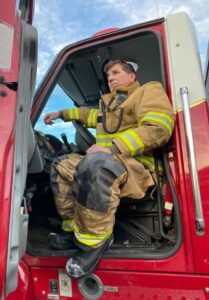 Name: Todd Shelley
Title: Captain
Department: Ickesburg Volunteer Fire Company
Location: Ickesburg, PA
Why are you an NVFC member?
I wanted to learn of the latest topics affecting the fire service and get factual information from respected sources.
What is your occupation?
Retired
Why are you a fire service volunteer?
When I was 16, my younger sister was struck and killed while riding her bicycle. Our village had no rescue or ambulance service. The fire company was, by definition, a “fire” company; it put water on fires. It consisted of an old 2,000-gallon oil delivery truck converted to a tanker/tender and a dump truck converted to a 500-gpm pumper with a 1,000-gallon tank. No members had any rescue or EMS training.
I joined to make a difference so that others might not feel the helpless pain that my family did as we waited nearly 30 minutes for medical assistance to arrive. Soon afterward, the community raised money to buy its first used ambulance. In turn, the fire company bought an Army surplus ambulance to be used as a rescue vehicle. They stocked it with rescue tools and EMS supplies, and members were then required to have CPR and Basic First Aid training.
More than 40 years later, our fire company is blessed to have a team of 30-plus volunteer firefighters, including EMRs, EMTs, paramedics, and nurses. The reason I am still active in my 60s is that I believe you lead by example and foster a sense of community. Hopefully, my actions will inspire others.
What year did you join the fire or emergency services?
1978
What are your memorable moments as a firefighter or EMS provider?
The fire service is a rollercoaster of emotions. You never forget the first heartache of a fatality from an auto accident. Conversely, you never forget the exhilaration of your first “save” on a cardiac arrest and the tears of joy from the patient’s family.
When you are young, you are fearless until the first structure fire humbles you and teaches you respect. Through the years, you learn to look at an incident three-dimensionally rather than from ground level. A 360 size-up and PAR accountability become priorities so the guys and gals in the trenches can focus on their tasks and everyone goes home safely.
What contributions have you (and your department) made in your community?
Traditionally, the fire company was a male-dominated organization. Women and teenagers were frowned upon in the egotistical culture in which we lived. Joining as a teenager, I worked hard to be accepted and recruited more teens to join. We started a junior firefighter program. In addition, we were one of the first companies in the county to actively recruit women for active roles rather than traditional tasks such as serving drinks and food at fires. We do an average of four school visits per year to the Amish community to provide fire prevention education and start planting the seed for future firefighters.
We have a large rural territory, and response times can take 15-20 minutes in remote areas. Because of this, we purchased four additional AED units and placed them in the four corners of our district with firefighters in hopes of increasing the chances of positive lifesaving outcomes.
We have instituted a mandatory wildland firefighting program for our members because we are heavily forested and include state game lands used for hunting. Last year, we held our first tree stand rescue class as part of a hunter safety initiative.
What practices help you stay physically and mentally strong for your crew?
Every year, we encourage our members to form two-person teams to compete in the county Firefighter Challenge in September. This event is a grueling competition that our members train for throughout the summer to refine their firefighting skills and physical strength. It includes carrying 165-pound mannequins, racing up two flights of stairs to lift hose to the top of scaffolding, advancing hose lines, and more.
This past year, we asked our insurance company’s risk management team to meet with our members. This mandatory session focused on members’ mental well-being. It was a closed meeting that allowed members to better understand how to handle the pressures and stress of everyday life and the fire service. Several members took advantage of additional counseling outside of the meeting.
It will become an annual required training, and all members will be expected to attend. In addition, we now have mandatory debriefings after all major incidents so members don’t take the stresses of the “job” home with them.
Interested in serving your community? Find volunteer fire service opportunities at www.MakeMeAFirefighter.org.