Heat Stress and PPE
September 2, 2025
Article first appeared on FireRescue1
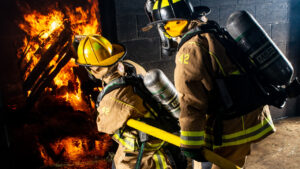
Photo courtesy of MSA Safety
Firefighters encounter extreme situations more frequently in any given week than many people do throughout their entire lives. The dangerous conditions a fireground presents can lead to a number of injuries and even fatalities, but often in unexpected ways.
A study conducted from 1977 to 2002 found that 45% of all on-duty firefighter deaths were the result of cardiac events. What’s more, 36% of these fatalities were directly correlated to fire suppression activities – tasks that involve immense exertion in high-heat environments.
More recently, the National Fire Protection Association (NFPA) published a report in 2022 examining the leading causes of injury on the fireground and came to a similar conclusion regarding the extreme nature of fire suppression activities. It found that 48% of all reported on-duty injuries resulted from exposure to heat and flame and overexertion.
Given that firefighters’ daily duties repeatedly put them in harm’s way, it’s important to make sure all efforts are being made to focus on health and safety. Prioritizing getting enough sleep, eating a healthy diet, and limiting alcohol consumption are often talked about, but there’s another way to promote firefighters’ well-being – careful consideration of the breathability of their turnout gear.
While turnout gear’s main function is to help protect a firefighter from high heat, direct flame, sharp objects, and more, it should also address the management of heat stress, a significant contributing factor of cardiac illness.
Understanding Heat Stress
Anyone who has donned and worked in turnout gear knows that sweating in their pants and jacket is a given. While today’s turnout gear is designed to provide protection against the challenges of the fireground, in some instances, it might contribute to increased overheating.
When firefighters are running into a burning building or even just doing perimeter control, it takes very little effort in the gear they’re wearing to increase their body temperature.
Instead of focusing solely on turnout gear’s thermal protection, firefighters need to be just as aware of how their garments can help to keep their body temperature in check. But how hot is too hot when you’re confronted with a fire?
The effects of heat stress begin to affect firefighters with even the slightest increase in body temperature. An increase to 99.5 degrees Fahrenheit, just 0.9 degrees higher than what is considered normal, will begin to impact one’s hearing. At this temperature, it’s easier to miss audible signals and firefighters may not react appropriately to certain noises.
A mere 0.4-degree additional increase begins to put firefighters in a true danger zone, as heat exhaustion sets in and it’s far more likely that medical aid will be needed. If a firefighter continues to work despite overheating and their body temperature reaches 100.2 degrees Fahrenheit, the chance of injury becomes very real.
At this temperature, motor control begins to diminish, leading to a loss in dexterity. It may also contribute to slower response speeds, making it dangerous to work in an environment where conditions can change at a moment’s notice.
If a firefighter’s body temperature reaches 100.9 degrees Fahrenheit and they continue to operate on the fireground, significant cognitive impairment can occur. Under these conditions, it can be difficult to recall information, solve simple problems, and think quickly. This level of heat stress presents a significant safety concern and can contribute to a cardiac event.
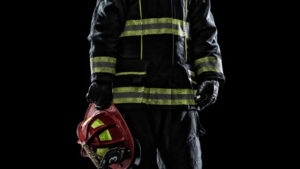
Photo courtesy of MSA Safety
How Breathability Plays a Role
Since a firefighter’s body temperature can rise quickly during fire suppression activities, it’s important to make sure their turnout gear aids in reducing the effects of heat stress. Their PPE needs to strike a balance between offering protection while remaining comfortable and breathable.
Our bodies are constantly exchanging heat with our environment, whether we’re on the fireground or sitting at a desk. The clothing we wear plays a role in modifying this heat transfer and in some cases, can be detrimental.
If the heat gains, either coming from the environment or through internal heat generation due to work, cannot be balanced by heat dissipation, excess heat will build and core body temperature will begin to rise.
Even more important than the outer shell or thermal liner, the moisture barrier is the primary layer that affects turnout gear’s level of heat dissipation. It’s measured by two factors: Total Heat Loss (THL) and Evaporative Resistance (Ret).
The higher a material composite’s THL is, the easier it is for a firefighter to shed excess body heat. The lower the Evaporative Resistance (Ret), the less resistance the material composite creates for evaporation (aka sweat vapor) to move through it.
Breathability Testing Explained
THL renders its results through a complex equation that calculates a combination of wet heat loss (evaporation) plus a dry heat loss (through conduction), so a higher number is typically better. The environment at which the test is run is 77°F with 65% relative humidity. Evaporative Resistance (Ret) focuses strictly on wet heat loss or evaporation. The result is a value that indicates how much resistance a composite creates for evaporation (aka sweat vapor) to move through it, so a lower number or less resistance is better. The environment at which the test is run is 95°F with 40% relative humidity.
Mitigating Heat Stress with Turnout Gear
With firefighter health and safety at the forefront, departments are increasingly looking for turnout gear that aids in breathability and helps promote sweat evaporation while maintaining its performance after multiple heat exposures and wash cycles.
When making a decision on turnout gear, attention should be paid to THL and Evaporative Resistance (Ret) levels. Traditional turnout gear is oversized to allow for air trapped between the composite layers to insulate firefighters from heat. Today, there are options for turnout gear using technical fabrics that allow a more body-contoured fit with less bulk that can maximize firefighters’ range of motion while promoting breathability. While the science behind breathability can be complex, selecting the right turnout gear makes it easier to help manage heat stress.