Beyond Borders, Breaking Boundaries
December 23, 2025
By Kevin D. Quinn
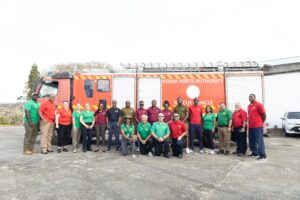 A little more than a decade ago, I met David Moore at a national advisory committee meeting, representing fire service organizations across the United States. During our conversation, David shared his involvement with Africa Fire Mission (AFM), an organization dedicated to building sustainable fire service capacity in developing communities. AFM fulfills this mission through training, empowerment, support, and encouragement, leaving systems in place that continue to grow long after the team returns home.
That conversation planted a seed I carried for years. I hoped someday to join AFM – not just to travel, but to serve alongside firefighters and leaders who use their gifts to strengthen those protecting their communities with extremely limited resources. Eventually, I had the opportunity to meet Nancy Moore, AFM’s executive director, whose leadership and compassion drive the organization’s vision. Together, we worked toward securing a spot for me on a future deployment. The application process was streamlined, seamless, and swift. This year, that dream became a reality.
I traveled to Nairobi, Kenya, where the AFM team gathered before flying to Mombasa for the 2025 International EMS and Fire Training Symposium and Competition. But before we began fire/EMS instruction, we visited the Missions of Hope International (MOHI) school in Nairobi, and that is where the deeper purpose of the mission truly came into focus.
MOHI itself began with a calling placed on the hearts of its founders, Mary and Wallace Kamau. Years ago, they saw the overwhelming needs inside the Mathare Valley “slums” (unplanned settlement) – hunger, illness, violence, unemployment, and entire families surviving on less than the cost of a cup of coffee. Instead of turning away, they leaned in. Starting with a small outreach effort, their mission grew – fueled by prayer, resilience, and a belief that every child deserves dignity, education, and opportunity. Today, MOHI operates schools, health programs, vocational training, and spiritual support for thousands across Kenya. Their legacy isn’t just organizational – it’s personal, relational, and transformational. I witnessed first-hand as their many social workers developed relationships and trust, infiltrating a population in dire need and making an incredible difference in so many lives.
One of our first community visits was to Mathare, one of the largest unplanned and informal settlements in Nairobi and home to nearly one million people. This represents one-fifth of the entire Nairobi population. Life there is unimaginably challenging. Many families live inside small tin structures, without running water, safe heat, or sewer systems. For some, one meal per day – not nutritious, not guaranteed – is considered a blessing. Children walk narrow paths above open wastewater. I was moved by the many children that approached me along the narrow pathways, each one reaching for my hand. Not for a giveaway, but for hope and faith. Their smiles were precious. Parents work tirelessly to survive another day. Yet, despite hardship, there is vibrancy, laughter, faith, and resilience woven into every corner. I was completely moved, this experience most certainly was eye-opening and life changing. In thinking back, I believe that gesture of hope among the children was a sense of humanity at its very core. Their message of “Hold me and we can walk together” was uplifting. It is a symbol of their faith and understanding. I was touched!
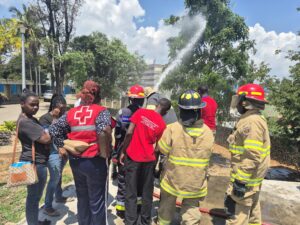
AFM partners with MOHI to strengthen this community through fire prevention education, safety outreach, and the development of local emergency response capabilities. Standing there – seeing the vulnerability and yet the extraordinary strength – reminded me exactly why this work matters. I later learned that AFM and MOHI also work with the local government officials and were a part of introducing a major road and pathways built through the “slums” of Mathare to provide emergency response vehicles to help those in need. Prior to that major road and those pathways being built, fires were devastating. Many lives were lost due to the lack of emergency response capabilities. The work of these organizations is truly remarkable. Their combined progress is slowly changing and saving lives throughout Africa, with other counties now demanding similar changes. Their lives matter and the governors of those counties are hearing the voices. AFM and MOHI are making a huge difference.
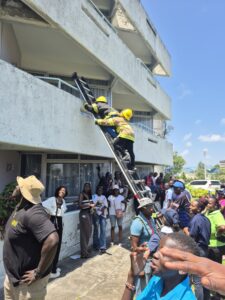
During our visit, I had the privilege of meeting Maria and two of her three children in their home. The space was small, modest, and humble – yet filled with warmth and dignity. Speaking with her was moving. Despite circumstances many would describe as impossible, her faith, optimism, and self-respect stood taller than any barrier around her. I learned that in her shanty there were some 65 families, each with multiple household members. The tiny space served as their bedrooms, living area, kitchen, and gathering area. Simple, but home. They had to walk a distance to the public toilet. With no running water, dangerous electrical, and potential fire conditions and fuel load, the work on fire prevention is essential. Yet, Maria spoke with such optimism and faith. That conversation will stay with me forever.
After our time in Nairobi, the team traveled to the Bandari Maritime Academy in Mombasa, where we joined firefighters and EMS professionals from across Kenya – and even from Uganda. There were 550 participants attending the symposium. The courses that were offered were:
- Pre-Hospital Trauma Life Support
- Basic Life Support
- Advanced Cardiac Life Support
- First Aid
- Community Fire Prevention (train the trainer)
- Water Rescue
- Swimming
- Hazardous Materials
- Incident Command Systems
- Emergency Vehicles Operations
- Tactical Firefighting
- Active Bleeding Control
- Leadership in Fire and Emergency Services
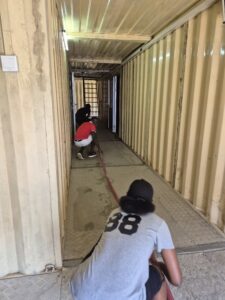 I had the honor of instructing participants in leadership within the fire and emergency services, alongside a dedicated Kenyan co-instructor and fellow AFM teammates. While I arrived ready to teach, I left deeply enriched by the Kenyan responders. Their hunger for knowledge, adaptability, service mindset, and determination were nothing short of inspiring. I have taught for most of my life, and rarely have I seen such engagement, passion, and unity of purpose. As I spoke, so many heads were bobbing in agreement. These leaders’ thirst for knowledge was extremely intense.
Once the symposium concluded, we traveled west into Narok County, eventually reaching the Maasai Mara National Reserve in the Great Rift Valley. There, I experienced the breathtaking beauty of Africa – landscapes alive with history, wildlife, and culture. A two-day safari allowed quiet reflection and a deeper appreciation for the land and its people. This journey was far more than a deployment or training assignment. It was a reminder of why we serve – why training matters, why capacity building matters, and how the global fire service brotherhood and sisterhood share a common mission regardless of borders, uniforms, or language.
I am humbled, grateful, and changed. And for me, this is only the beginning.
I’m working with the National Volunteer Fire Council and Africa Fire Mission to offer a webinar on the experience. Information and registration will be available soon at www.nvfc.org/online-trainings.
If you would like to learn more about the Africa Fire Mission and how to get involved, visit www.africafiremission.org.
Kevin D. Quinn has been in the fire service since 1976. He served as deputy chief of the Union Fire District in South Kingston, RI, is a past chair and current Rhode Island director for the National Volunteer Fire Council, and a past president of the Rhode Island State Firefighters’ League.